
Journaling
When I taught high school English classes, I encouraged students to use the practice of marking a text that I had learned in graduate school as a way to interact with what they read. (Of course, you must own the book or have a copy of the page if you mark it. Libraries and even friends frown on marking their books.)
Marking has many variations: underlining what you want to remember, noting a fact to look up later, drawing a question mark next to something you don’t understand, or an exclamation point when you agree, or a star to remember it, or even writing your own statement as if conversing with the author (or next reader) about the text.
The Bible is the most important text we can read, and the Author encourages our interaction. Although some people are fine with marking in their Bibles, others are not, and I know of no edition that provides enough room on a page to write a thorough response to a verse or passage. You can buy books with preselected passages or chapters of the Bible printed on one side and lines to write on the opposite page. These are excellent study and prayer aids, but a simple notebook allows freedom to write a passage and as much or as little as is on your heart.
In the last two years, I have begun to reread the Bible slowly and pause to meditate on verses and passages I had marked in previous readings, sometimes making observations and sometimes breaking into prayer. Recently, I completed reading Psalms, meditating on and praying about the words I had marked. Like heavenly encouragement to share these journal pages, a recent sermon at church was on spending time in the Word—reading a passage (bold in these posts), meditating on it (regular font, sometimes in parentheses), then praying it (italics in these posts). The pastor even demonstrated using Psalm 33. For the next five days, instead of my thoughts being supported by Scripture, the words of Scripture are central, accompanied by thoughts and prayers.

The last five psalms begin and end with “Praise the LORD!” They follow five psalms of David, Psalms 141–143, that begin with cries for help, begging God to hear him, and the last two begin with a resolve to look at all God has done for him and to worship. In Psalms 144 and 145, the praise is thoughtful and reserved, not spilling out with the almost giddy delight of the last five psalms, but with focused effort and intent to turn the writer’s heart from groaning to gratitude. The last five psalms give no author’s name, but perhaps none is needed because, as David closed Psalm 145:
My mouth will speak the praises of the LORD, and all flesh will bless His holy name forever and ever.
Psalm 145:21
These are songs for all of God’s people to sing!
LIFE-GIVING ENCOURAGEMENT
What joy it will be to join the heavenly chorus and sing unrestrained praise. But why not now? Do songs of praise not carry us through our days on earth? Do You, O Lord, not use our songs of praise to fight the enemy?
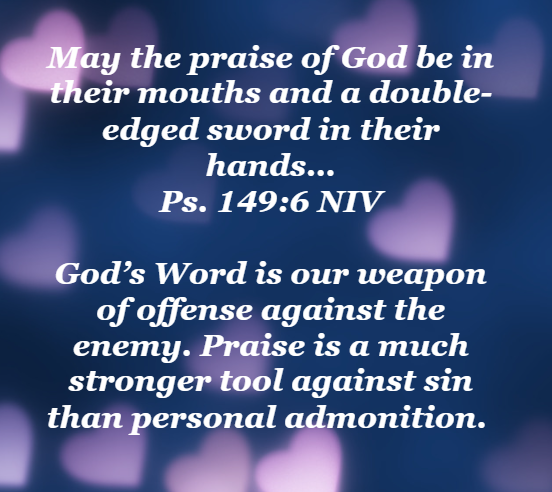
May the praise of God be in their mouths and a double-edged sword in their hands…
Ps. 149:6 NIV
God’s Word is our weapon of offense against the enemy (Eph. 6:17, Heb. 4:12). Praise is a much stronger tool against sin than personal admonition.
Over the next few days, I am sharing excerpts from my personal journal as one example of how to journal Scripture, with the hope that it will help those who struggle with journaling as a tool for growing in faith.
PRAYER
Today, Lord, may I fight for joy and fight with singing. May praise bubble up, spill out, and overflow. May Your song fill my lungs, and may my lips open in singing for all to hear as I march into battle against the grumbling, fear, and complacency which make me a prisoner of self even after You have set me free. Amen.
Marlys Roos is the publications coordinator for the PCA’s Committee on Discipleship Ministries. She, her husband, and son live in Atlanta and are members of Perimeter Church.


Are there other women in your life who could benefit from a daily dose of encouragement? Forward this email so they can click on this link to Subscribe to Daily Treasure to be better equipped to walk by faith on the pathway God has marked out for them.
Sharon W. Betters is a mother, grandmother, great-grandmother, pastor’s wife, and cofounder of MARKINC Ministries, where she is the Director of Resource Development. Sharon is the author of several books, including Treasures of Encouragement, Treasures in Darkness, and co-author with Susan Hunt of Aging with Grace. She is the co-host of the Help & Hope podcast and writes Daily Treasure, an online devotional.
Contact Sharon with comments or questions at dailytreasure@markinc.org.